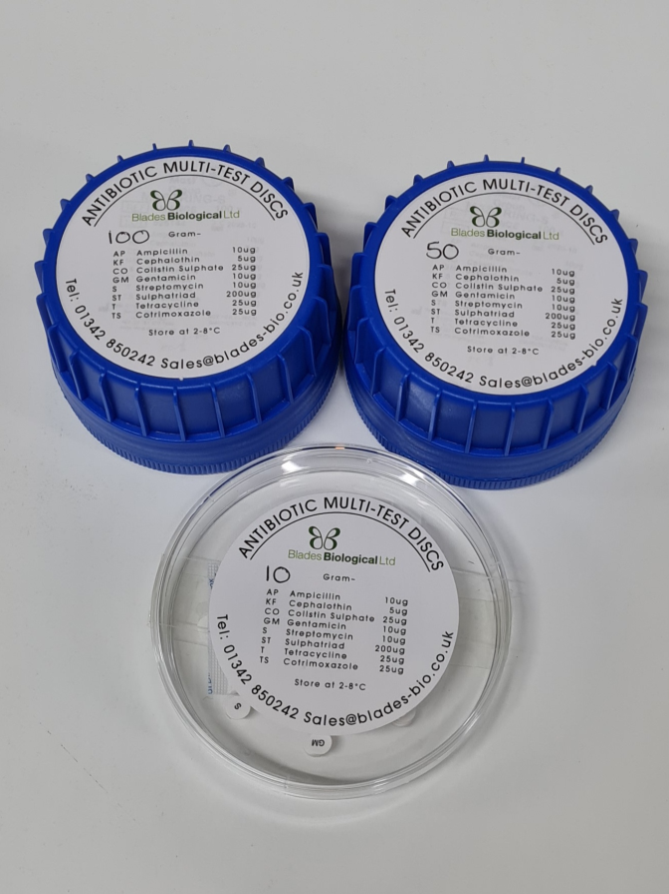
What can a small paper disc tell us about the response of bacteria to an antimicrobial compound? In a well-designed classroom microbiology practical, the answer can provide a clear visual demonstration of antibiotic susceptibility and introduce students to an important principle of microbiology: bacterial populations do not necessarily respond to every antibiotic in the same way.
Antimicrobial resistance is also an increasingly important scientific and public health concern. The World Health Organization identifies antimicrobial resistance as one of the major global health threats, making it increasingly valuable for students to understand how susceptibility testing provides evidence about bacterial responses to antimicrobial agents. For educators planning classroom microbiology practicals, selecting appropriate discs is therefore an important part of producing meaningful experimental results.
At Blades Biological, we provide laboratory materials for educators, including bacterial cultures and antibiotic discs that can support structured microbiology teaching. When educators buy bacterial cultures and antibiotic discs from a specialist biology supplier, they can select materials appropriate to the intended practical and learning objectives.
This guide examines antibiotic discs, how they are used in susceptibility experiments, and the main factors educators should consider when choosing antibiotic discs online.
What Are Antibiotic Discs?
Antibiotic discs are small absorbent discs containing a defined quantity of an antimicrobial substance. In a standard disc diffusion susceptibility experiment, a disc is placed onto an agar surface containing a bacterial culture.
As the antimicrobial compound diffuses through the agar, it can inhibit bacterial growth in the surrounding area. This may produce a visible zone of inhibition, which can then be assessed as part of the practical.
The principle is straightforward, but the educational value is significant. Students can observe how different antimicrobial compounds can produce different patterns of bacterial growth inhibition and learn why experimental controls, standardisation and measurement matter in microbiology.
How Are Antibiotic Discs Used in Sensitivity Experiments?
Disc diffusion methods are commonly associated with the Kirby-Bauer approach to antimicrobial susceptibility testing. In an educational setting, the method provides an accessible way to introduce several core microbiological concepts.
A typical practical involves:
- Selecting an appropriate bacterial culture
The organism used should be suitable for the educational setting and the intended learning outcomes. Educators can buy bacterial culturesfrom established laboratory suppliers with relevant information about the culture. - Preparing the culture and agar according to the laboratory protocol
Consistency is important because variations in the culture conditions or agar can influence the observed result. - Applying the antibiotic discs
Discs containing different antimicrobial compounds can be positioned on the prepared agar so that their effects can be compared. - Allowing the experimental system to develop under the specified laboratory conditions
The practical should follow the supplier’s instructions and the institution’s approved microbiology procedures. - Observing and measuring inhibition
Students can record the presence and size of zones of inhibition and compare results between antimicrobial agents.
The resulting measurements can then form the basis for discussion about bacterial susceptibility, experimental variability and antimicrobial action.
Which Factors Should Educators Consider When Buying Antibiotic Discs?
Not every set of antibiotic discs will be appropriate for every classroom practical. Before educators buy antibiotic discs, we recommend considering several scientific and teaching-related factors.
1. The Antibiotic or Antimicrobial Agent
Different discs contain different antimicrobial compounds, and each has a distinct mechanism of action. Depending on the curriculum, educators may wish to compare compounds that affect bacterial cell wall synthesis, protein synthesis or other cellular processes.
Selecting a suitable range can help students connect an observable phenotype, such as growth inhibition, with underlying cellular biology.
2. Disc Potency
The quantity of antimicrobial compound contained within a disc matters. Results obtained using discs with different potencies should not be compared without considering the relevant specifications.
When purchasing antibiotic discs online, educators should therefore check the stated concentration or potency and ensure that the discs are appropriate for the planned practical.
3. The Bacterial Species
Antibiotic susceptibility varies between bacterial species and strains. A disc that produces substantial inhibition with one organism may produce a different result with another.
This makes the relationship between the bacterial culture and selected discs particularly important. If you buy bacterial cultures online for a susceptibility experiment, check that the organism is appropriate for the intended educational activity and compatible with the selected antibiotic discs.
4. The Learning Objective
The most appropriate discs depend on what students are expected to learn.
For example, a practical focused on:
- antimicrobial susceptibility may use several antibiotic discs for comparison;
- bacterial physiology may emphasise differences in responses between organisms;
- experimental design may focus on controls, repeat measurements and sources of variation;
- data analysis may require students to record, compare and interpret inhibition zones.
Choosing discs according to the learning objective keeps the experiment scientifically focused rather than treating the discs simply as demonstration materials.
Why Standardisation Matters

A major teaching opportunity in antibiotic susceptibility practicals is demonstrating that experimental observations depend on controlled conditions.
Factors such as the bacterial inoculum, agar characteristics, disc potency, disc placement and incubation conditions can influence the resulting inhibition zones. Students should therefore understand that a larger or smaller zone is not automatically sufficient evidence for making a broad statement about antibiotic effectiveness.
This distinction is particularly useful when teaching scientific methodology. Measurements should be interpreted within the conditions under which they were produced.
Educators can ask students to consider:
- Were the same conditions applied to each sample?
- Were measurements recorded consistently?
- Were appropriate controls included?
- Could technical variation have influenced the results?
- What conclusions are supported by the data?
These questions turn a simple microbiology practical into an exercise in evidence-based interpretation.
Build a Stronger Practical With the Right Laboratory Materials
What makes a microbiology practical genuinely valuable to students? It is not simply the presence of visible bacterial growth or a measurable zone of inhibition. The strongest practicals connect observation with biological theory and encourage students to assess evidence systematically.
Blades Biological supports educators by supplying laboratory materials for biology teaching, including bacterial cultures and antibiotic discs suitable for educational laboratory applications. Our range gives educators a practical source when they need to buy bacterial cultures or buy antibiotic discs online, with product information available to help inform material selection.
For educators planning classroom microbiology practicals, choosing compatible cultures and antibiotic discs can help create experiments that reinforce microbiological principles while giving students experience with observation, measurement and scientific interpretation.
Browse the Blades Biological range of antibiotic discs online and bacterial cultures online to identify laboratory materials suited to your teaching requirements, and order the products needed for your next microbiology practical.