Could a microscopic green alga become one of the most useful organisms in a biology classroom?
For educators teaching cell biology and photosynthesis, the answer can be yes. Living cultures give students a biological system they can observe, sample and measure rather than relying only on diagrams or preserved material.
Scenedesmus quadricauda is particularly suitable because its growth responds to measurable variables including light, temperature and nutrient availability. Recent research found that light and temperature accounted for substantial variation in its biomass production.
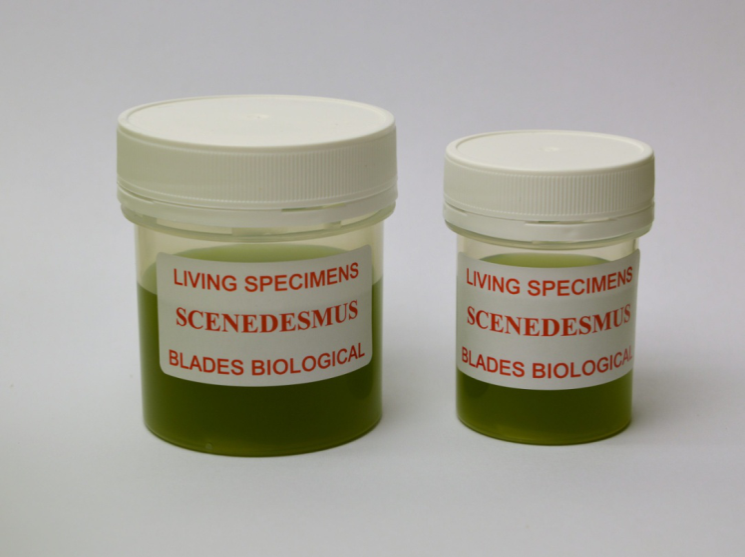
At Blades Biological, we provide live algae cultures and growth media for educators who want practical biological material for structured laboratory work. Our range includes Scenedesmus quadricauda, algae for sale for classroom investigations, and materials that can also support practical activities involving algae balls.
In this guide, we explain the biological requirements of S. quadricauda, how we can maintain a culture, what students can observe, and how live cultures can strengthen teaching about photosynthesis and cellular processes.
Understanding Scenedesmus quadricauda
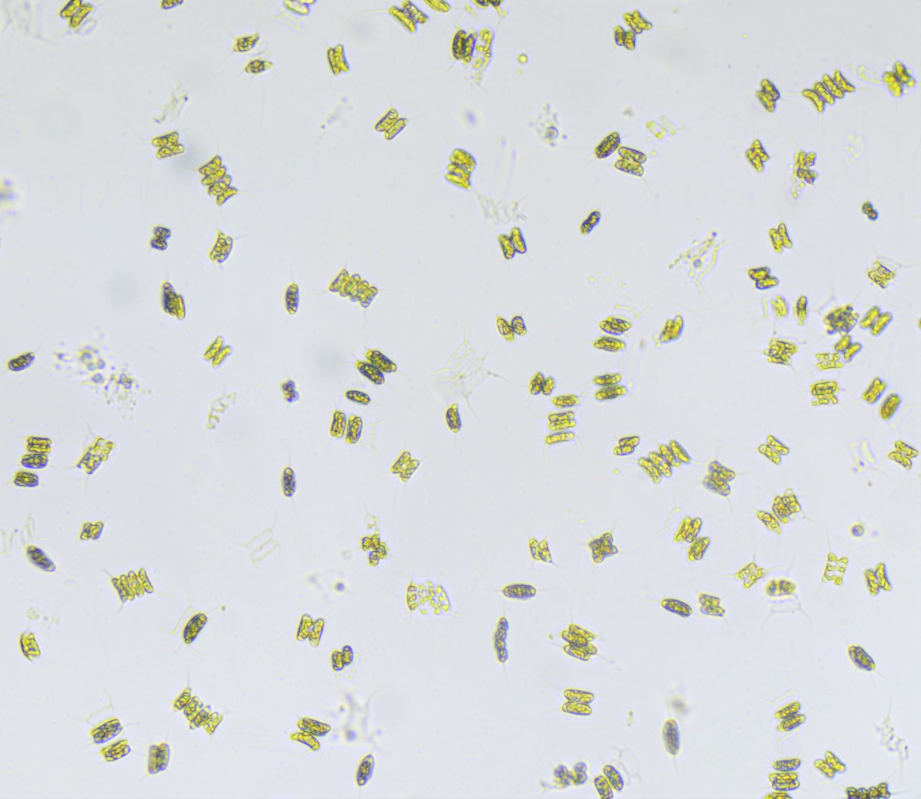
Scenedesmus quadricauda is a freshwater green microalga within the Chlorophyta. It is commonly encountered as colonies containing four cells, although other colony arrangements can occur. The cells contain chloroplasts and carry out oxygenic photosynthesis, making the organism particularly useful for teaching how light energy is converted into chemical energy.
A live culture can support lessons covering:
- Chloroplast function
- Photosynthetic carbon fixation
- Light-dependent reactions
- Population growth
- Nutrient uptake
- Environmental factors affecting algal biomass
- Experimental design and data analysis
Unlike preserved specimens, a live algal culture provides an active biological system in which environmental conditions can be changed and subsequent responses measured.
What does Scenedesmus quadricauda need to grow?
Successful culturing depends on controlling several variables rather than simply placing algae in water and providing light. We should treat the culture as a biological system with defined nutritional and environmental requirements.
1. Use an Appropriate Growth Medium
- quadricauda requires dissolved nutrients for cellular growth and metabolism. A formulated freshwater algal medium provides sources of essential elements, including nitrogen and phosphorus, together with other mineral nutrients.
Alga-grow is frequently used for laboratory cultivation of this species, while other established algal media can also be appropriate depending on the strain and experimental objective. Research has demonstrated successful S. quadricauda cultivation in Alga-grow under controlled conditions.
For classroom work, using a defined growth medium has an important advantage: students can relate observed changes in biomass to known environmental variables rather than an uncontrolled mixture of nutrients.
2. Provide a Consistent Light Source
Light supplies the energy required for photosynthesis. We should therefore provide consistent illumination rather than placing cultures where exposure changes considerably throughout the day.
A practical teaching culture can be maintained using artificial illumination on a controlled light-dark cycle. Published studies have used photoperiods ranging from 12:12 to 16:8 hours of light and darkness, depending on the experimental design.
We should also avoid assuming that more light always means better growth. Excessive irradiance can cause photoinhibition, while insufficient light can restrict photosynthetic activity. Research on S. quadricauda has demonstrated that growth varies with both light intensity and wavelength.
3. Maintain a Suitable Temperature
Temperature influences enzyme activity, membrane processes, nutrient uptake and photosynthetic performance.
For routine classroom maintenance, a stable temperature around room temperature is practical. Blades Biological recommends approximately 22°C for its supplied culture for strong growth.
The important principle is consistency. Sudden temperature fluctuations can introduce an uncontrolled variable into an investigation and make comparisons between samples less reliable.
4. Maintain Gas Exchange and Suspension
- Quadricauda is non-motile, so the culture should not simply be left undisturbed. Gentle agitation helps maintain cells in suspension and improves contact between the culture and surrounding medium.
For small classroom cultures, we can achieve this through regular gentle swirling. Where appropriate laboratory equipment is available, an aquarium air pump can provide continuous aeration. Blades Biological recommends agitation or aeration as part of routine culture maintenance.
A Simple Maintenance Routine
Once we have established a culture, consistency is more important than complicated equipment. We can use the following routine:
- Check the culture visually.Look for changes in colour, sedimentation or unusual growth.
- Check the temperature.Record it alongside other observations.
- Assess illumination.Confirm that the light source and photoperiod remain consistent.
- Maintain aeration or agitation.This helps prevent excessive settling.
- Monitor culture density.Optical density, cell counting or simple visual comparisons can provide useful data.
- Subculture when required.Transfer an appropriate portion into fresh growth medium before nutrients become limiting.
Keeping a written record turns routine culture maintenance into an opportunity for scientific data collection.
Turning A Live Culture Into A Cell Biology Investigation
A culture of Scenedesmus quadricauda can become the foundation for several algae science experiments.
Investigating Light and Photosynthesis
We can divide a culture into comparable samples and expose them to different light conditions. Students can then record changes in biomass, optical density or another measurable indicator of photosynthetic activity.
This allows students to identify:
- Independent and dependent variables
- Controlled variables
- Replicates
- Quantitative measurements
- Trends and anomalies
- Appropriate graph types
- Limitations within experimental design
The activity moves photosynthesis from an abstract biochemical pathway to a measurable physiological process.
Studying Nutrient Availability
Nitrogen and phosphorus are fundamental to algal growth. We can use controlled nutrient conditions to demonstrate how resource availability influences biomass accumulation.
This also provides a useful connection between cellular requirements and freshwater ecology. Research has shown that nutrient availability can influence not only biomass production but also the biochemical composition of S. quadricauda.
From Culture Maintenance to Meaningful Biological Data
What happens when students stop simply looking at algae and start treating the culture as an experimental system?
The learning value increases substantially. A well-maintained Scenedesmus quadricauda culture can support lessons in which students formulate hypotheses, identify variables, collect quantitative observations and interpret biological data. The same culture can be incorporated into microscopy, photosynthesis investigations, nutrient studies and algae balls activities.
For educators, this makes live algae cultures useful not merely as classroom materials, but as practical models for teaching fundamental biological principles.
At Blades Biological, we support practical biology teaching with live cultures, growth media, preserved specimens and other laboratory resources. Our selection of algae for sale includes Scenedesmus quadricauda for educational use, while our broader range supports practical teaching across cell biology and related life science subjects.
We also provide materials that educators can use when preparing algae balls for controlled photosynthesis investigations.
To begin a classroom culture project, browse and order the Scenedesmus quadricauda and suitable growth media available from Blades Biological. Using established biological materials gives us a practical starting point for structured experiments while helping students connect cellular theory with measurable biological processes.